01
Specify the decision the test must support
Explain whether the request concerns commissioning, an examination, a repair, modification or a particular functional concern. Identify the equipment and configuration. Checking that a hoist performs an agreed movement is not necessarily the same scope as proving a lifting accessory under a specified load. Ask the technical team to resolve that difference before pricing or arranging test equipment.
02
Do not choose a test load by habit
The responsible specialist should establish the test basis from the equipment information, manufacturer requirements and applicable project or technical standard. There is no universal multiplier or hold time for every item. Routine overload testing is not automatically required at every examination and can damage some equipment. Missing drawings or an unknown rating are reasons to resolve the scope, not to guess a test value.
03
Agree the controlled test arrangements
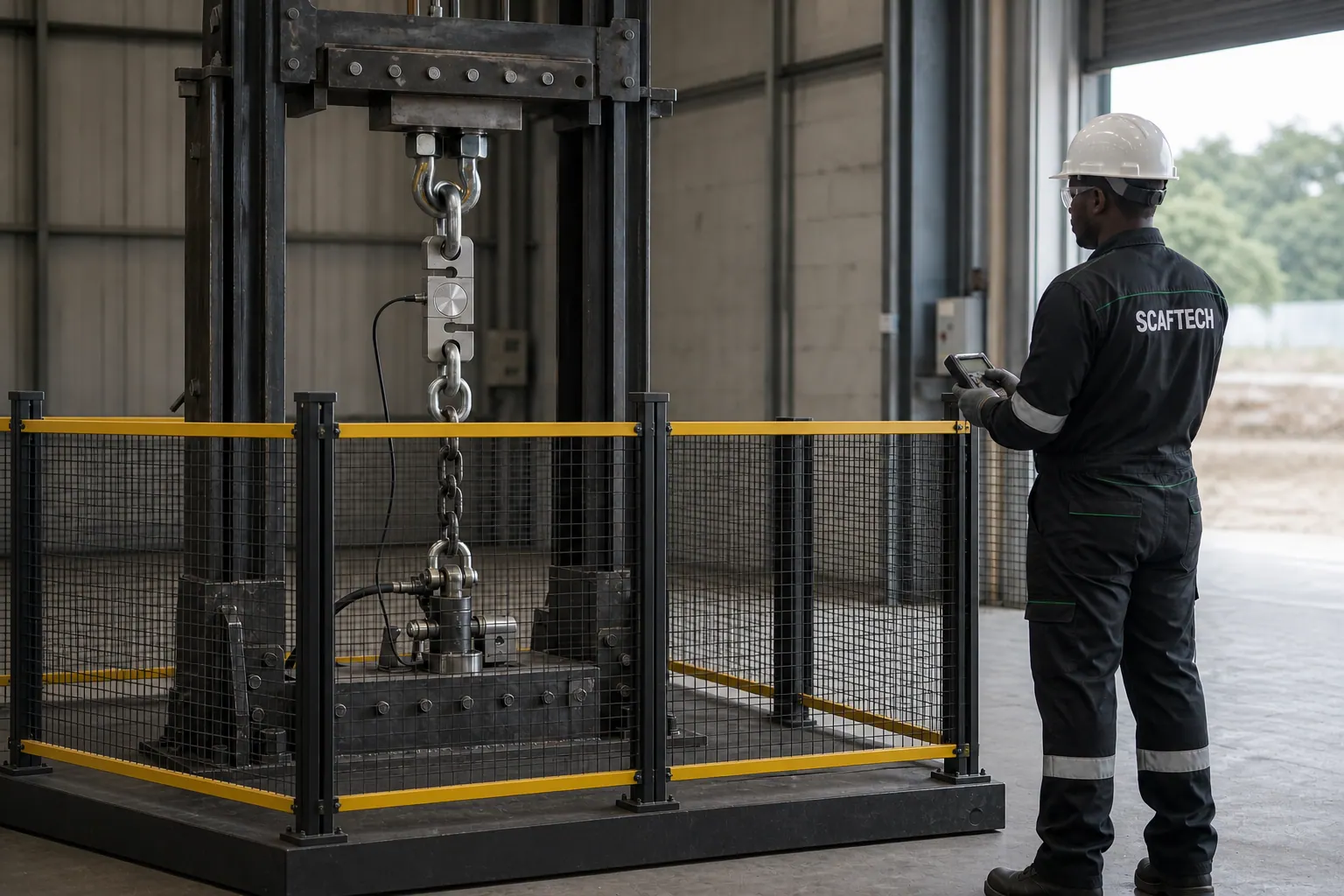
The test plan should identify the setup, applied-load measurement, relevant functions, acceptance criteria and responsibilities. Confirm the site can provide the agreed area, access, isolation and operational support. Test preparation and execution belong to competent personnel under an approved method. Do not improvise a loaded trial, defeat a safety device or use a live production lift as an informal proof test.
04
Keep the result within its tested boundary
The handover should connect the equipment identity and configuration to the test performed, recorded result, observations and any restriction or further work. Passing a test does not independently establish a new working capacity or guarantee future condition. Inspection and other technical evidence may still be needed. Share the decision you need to make with Scaftech when requesting Inspection, Load Testing & Certification.
Keep this checklist
Prepare a testing brief
- Equipment ID, rating and configuration to be tested.
- Reason for testing and previous examination or repair records.
- Manufacturer information and required technical basis.
- Site constraints and named test-plan approval responsibilities.
- Required report, acceptance decision and follow-up process.